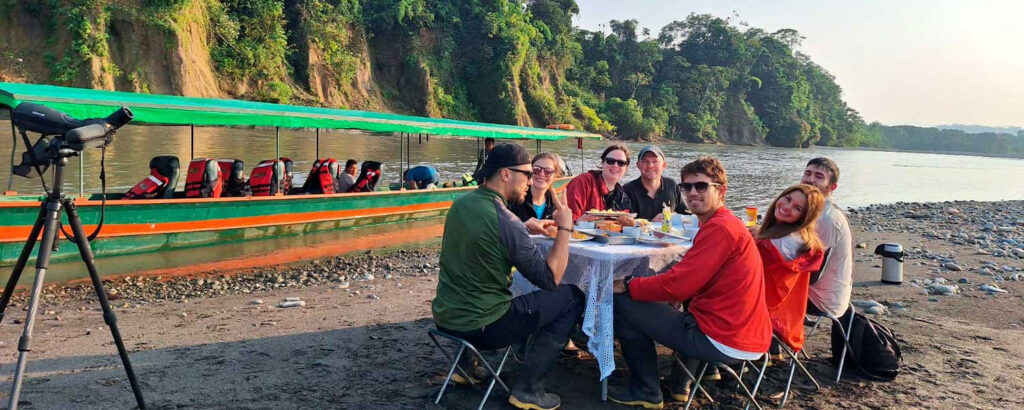
Manu Biosphere Birding Tours 15 days
Peru is one of the Top Birding Destinations in the World, you can find about 20% of the total species of the world, Birding in Peru is wonderfull and Manu National park is the crown Jewel of Peru’s Birding areas.

About this Expedition
Pristine Biodiversity
Immersion in primary forest trails and macaw or tapir clay licks with privileged viewing.
Native Guides
Bilingual guides from the native communities of Manu and Tambopata, with spotting scopes and binoculars.
Logistics and Lodges
Private transport and boats, a cook on the trip and nights in rainforest lodges.
Day-by-Day Itinerary
Biodiversity is Unique, nowhere else in the Andes is there an easily accessible road that Travels through Pristine Cloud Forest from the treeline down to the Lowlands! And at the bottom of the road, there is an excellent selection of Rainforest Lodges where you can comfortably bird one of the biodiverse habitats in the world, you will have the chance not only bird watching but also to see the fabulous endangered Wildlife of the Tropical Rainforest.
Day 01:Cusco City – Huacarpay Lake – Upper Manu Road – Cloud Forest.
We will drive out south of town 30km about it, we Start Birding at Huacarpay Lake, looking for high Andean wetland species like Many-coloured Rush-Tyrant and Plumbeous Rail, Puna, Yellow-billed and Cinnamon Teal, Yellow-billed Pintail and searching the adjacent scrub for Rusty-fronted Canastero, Streak-fronted Thornbird and a variety of others. We’ll then make the drive through the dry Andes towards Manu, hoping to find three endemics en route: Chestnut-breasted Mountain-Finch, Bearded Mountaineer, and Creamy-crested Spinetail. Through the andes we can find Andes Ibis, Slender-billed Miner, with luck seasonal migrant Tawny-throated Dotterel, after short visiting the last andean picturesque village (optional), we drive to our first meeting with the most Pristine Forest – Manu National Park. In the afternoon we’ll have our first crack at the elfin humid forest, hoping for treeline specialties like Golden-collared Tanager, Grass-green Tanager, Hooded Mountain-tanager, Moustached Flowerpiercer, and – with lots of luck – the rare Scribble-tailed Canastero. Late in the day, we will have our first chance for one of the enigmatic and endemic red-and-white Antpitta & Rufous Antpitta.
We spend the night in the humid montane Forest, Enjoying the stars with the opportunity to look for some nocturnal Birds located in this area: Yungas Pygmy-Owl, Rufous-banded Owl, Swallow-tailed Nightjar. Night in comfortable lodge.
Day 02: Cloud Forest – Middle Manu Road – Cock Of The Rock Lodge
Early morning we will walk around lodge, looking for more high-elevation species like Grey-breasted Mountain-Toucan, Red-and-white Antpitta, Puna Thistletail, Marcapata Spinetail, Rufous-capped Thornbill, and many others, we’ll work our way down the Manu Road, birding the most productive areas. Possibilities are nearly endless, from relatively common specialties like Blue-banded Toucanet and Handsome Flycatcher to mega-rarities like Greater Scythebill and Andean Potoo. We should encounter some good flocks that could include a variety of tanagers as well as Versicolored Barbet, Striped Treehunter, Inca Flycatcher, and even Band-tailed Fruiteater if we’re lucky. In the not-so-rare but difficult category are Hazel-fronted Pygmy-Tyrant, Unadorned Flycatcher, and White-throated Antpitta… sound like enough to keep us busy for the day?.
We will spend the night in cloud forest in more temperate environment at 1400 meters of height less than the previous night (4593,176 ft,) in the ideal habitat for the Cock of the rock.
Day 03 – 04: – Manu National Park
We’ll have 2 full days into the cloud forest to see birds, – this is tanager paradise! Depending what birds we need, we’ll visit elevations from 800 m. – up to 2500 m. (2624,67 ft. – 8202,1 ft.). We can expect at least a couple great mixed flocks during our stay which could include Golden-eared (uncommon), Golden-naped, Black-goggled, Orange-Eared, Fawn-breasted, Yellow-throated, Spotted, Paradise, Golden, Bay-headed, and Black-goggled Tanagers, Golden-olive Woodpecker, Olive-backed Woodcreeper, Montane Foliage-gleaner, Grey-mantled Wren, Streak-necked, Slaty-capped and Lemon-browed Flycatchers, the restricted-range Bolivian Tyrannulet, Marble-faced Bristle-Tyrant, Tropical Parula, Russet-crowned and Three-striped Warblers, Slate-throated Whitestart, Golden-eyed (or Deep-blue) and Bluish Flower-piercers, Blue-naped Chlorophonia, the restricted-range Slaty Tanager, Yellow-throated and Common Bush-Tanagers, Black-faced (or Dark-faced) Brush-Finch (split from Rufous-naped). There is even an undescribed tanager species known from this location ( “Bamboo Tanager” – “San Pedro Tanager” ), although it appears to be very rare, Yellow-rumped and Yellow-breasted Antwren, Ash-browed Spinetail, and many, many more. Away from flocks we’ll search for Crested and Golden-Headed Quetzal, Andean and White-eared Solitaires, Amazonian Umbrellabird, and Solitary and Black-and-chestnut Eagles, rare and Difficult to detect Black-Streaked Puffbird.
The lodge gardens are visited by Many-spotted Hummingbird, Violet-fronted Brilliant, Booted Racket-Tail, and others, sometimes including Wire-crested Thorntail and the rare Buff-Tailed Sicklebill and of course Andean Cock-of-the-Rocks are frequently seen in the area – if all else fails, we can visit a lek!
Behind the garden there is a trail system where we can look for Chestnut-breasted Wren, Scaled Antpitta, Rufous-breasted and Short-tailed Antthrush’s, Slaty Gnateater and the endemic Cerulean-capped Manakin (very rare). Night birding is usually slow, but we should see Lyre-tailed Nightjar, Band-Bellied Owl and Rufescent Screech-Owl is also a possibility.
Day 05: Low Land of Manu Road – Pillcopata Lodge.
This day we’ll be focused on the lower part of the Manu Road where we’ll try for some very difficult endemic birds: Black-backed Tody-Flycatcher, Cerulean-capped Manakin, Peruvian Piedtail, and even an beautiful but undescribed tanager species known from this location ( “Bamboo Tanager” – “San Pedro Tanager” ), although it appears to be very rare, species of tanager are possible – feeling lucky? There are lots of others to hope for too, including Lanceolated Monklet, Two-banded Warbler, Chestnut-backed Antshrike, Stripe-chested Antwren, Versicolored Barbet, Golden-collared Honeycreeper, Fulvous-breasted Flatbill, Cinnamon-faced Tyrannulet, Ornate and Lemon-browed Flycatcher, Cabanis’s Spinetail.and many more birds Around mid-day we’ll have a quick look for some open country birds. we’ll arrive in the afternoon for a short walk around the Villa Carmen (biological station 500m – 1640,42ft ), this area will provide different selection of trails with special habitats in the southeast of South America “Bambo” where many specialties are restricted to this type of habitat and make bird watching so special around Manu National Park.
we have a night birding with some great night birds: Stripe, Black-banded and Spectacled Owl are some goodies that we can get, including Tawny-Bellied Screech-Owl (Garden guy)
Day 06: Amazon Foothill – Atalaya Port – Lost Lake – Manu Rainforest Lodge.
The bamboo forest offers a great selection of birds restricted to this habitat so we will be birding full morning looking for all possible specialties. Some of our bamboo targets are the wonderful White-cheeked Tody-Flycatcher, Manu, Striated, Goeldi’s, and White-lined Antbirds, Ihering’s Antwren, Bamboo Antshrike, Large-headed and Dusky-tailed Flatbills, Flammulated Tody-Tyrant, Rufous-capped Nunlet, and Brown-rumped and Dusky-cheeked Foliage-gleaners, Red-billed Scythebill, Dot-winged Antwren, Ornate Antwren and Rufous-breasted Piculet If we’re very lucky, we may also get Rufous-headed Woodpecker and Peruvian Recurvebill, but these are usually difficult and rare species, Fine-barred Piculet is one of the local endemic specie found in the area usually around the lodge, Including lowland hummingbirds as well as we can find some mammals – Monkeys, after lunch we leave the lodge, we have some birding on the way Yellow-billed Nunbird and Plain softail are our target before taking a short boat ride to Manu Rainforest Lodge 30 minutes down stream from Atalaya Port.
Scanning from the boat we’ll catch Fasciated Tiger-heron, Garden is wonderful, where we could find Rufous-crested Coquette, Gould’s Jewelfront, and Sapphire-spangled Emerald, Violet-headed Hummingbird, Blue-tailed Emerald, Koepcke’s Hermit (endemic species) rare visitor among a variety of other hummingbirds. A short afternoon walk will get us our first Hoatzin for the trip, Amazonian Antpitta, Black-capped & Cinereous Tinamou, Blue-throated Piping-Guan, Fiery-capped, Band-tailed and Round-tailed Manakins, Bluish fronted Jacamar, Chestnut-capped Puffbird, Spot-backed Antbird, and rare and local threatened Razor-billed Curassow are possible. In the evening, we have a good chance of seeing Tawny-bellied Screech-Owl, but the local Black-banded Owl – though we usually hear it – is much more difficult!
Day 07: Manu Rainforest Lodge – Amazon Basin – Machuawasi Oxbow lake.
We’ll spend most of the day at Manu Rainforest Lodge, first heading into the hill forest for the most difficult forest birding of the trip. Rewards are there to be found though; flocks typically include Half-collared Gnatwren, Spectacled Bristle-Tyrant, Carmiol’s Tanager, Cuzco Warbler, Yellow-browed Tody-flycatcher, and Rufous-tailed Antwren; with lots of luck we may also find Foothill Antwren, Brownish-headed Antbird or even Sapphire Quail-Dove or Grey Tinamou – now it’s really getting tough! We’ll also visit a White-browed Hermit lek, while other possibilities include Black and Spot-backed Antbirds, Ringed Antpipit, and Round-tailed Manakin. After a mid-morning walk we scan around the lodge (check for soaring raptors and swifts!), we’ll try the floodplain forest for Slender-billed Xenops, Fine-barred Piculet, Black-faced Antthrush, Amazonian Antpitta, Dark-breasted Spinetail,Speckled Spinetail Red-billed Tyrannulet, Black-banded Woodcreeper.
Day 08: Manu Rainforest Lodge – Boat Trip – Dorado Lodge.
After breakfast we’ll catch a boat down the river for 3 hours about, We’ll start our river bird list too; we should find Fasciated Tiger-Herons among the more common species, depending of the season, Boreal and Austral migrants are present (waders), as well as some different raptors. We’ll have time for an afternoon walk at the lodge; most likely we’ll head for the river edge forest to look for the beautiful Scarlet-hooded Barbet among others.
This Lodge has some of the best bamboo birding in the area; this will be the main focus of this day, though we will explore other habitats too. Some of our bamboo targets are the wonderful White-cheeked Tody-Flycatcher, Striated, Goeldi’s, and White-lined Antbirds, Ihering’s Antwren, Bamboo Antshrike, Large-headed and Dusky-tailed Flatbills, Rufous-capped Nunlet, and Brown-rumped and Dusky-cheeked Foliage-gleaners. If we’re very lucky, we may also get Rufous-headed Woodpecker and Peruvian Recurvebill, but these are usually difficult. Outside the bamboo we can expect good activity too; we may add Rusty-belted Tapaculo, Red-necked Woodpecker, and Striolated Puffbird, Golden-collared Toucanet, Great Jacamar to our list. And of course this is an amazing place for antbirds – we should build up a good list. Besides our main target birdwatching we have a great forest with lots of wildlife: monkeys 6 types at least, white-lipped Peccary Jaguar and many other surprises, around dorado Lodge there is small Macaw clay lick, here is the unique chance to see the endangered Blue-Headed parrot and some macaws.
Later we’ll wait on the beach for dusk to fall, watching various parrots and macaws flying over and then hoping for Sand-coloured Nighthawks and Ladder-tailed Nightjar.
Day 09: Macaw Clay Lick – Manu River – Otorongo Oxbow Lake – Casa Matsighenka Lodge.
We spend the best hours in the low land looking our targets species. then we take a boat toward Manu National Park, Most of the birding tours don’t visit this area, we’ll visit Casa matsiguenka, this lodge is managed by local community all the staff are coming from Tayacome and Yomibato Matsiguenka community
Manu National park has incredible biodiversity in the world, this place can offer to show us innumerable quantity of birds and mammals, even with the really small chance, here we have the best opportunity to see the wildlife like the mythical tropical rainforest predator “Jaguar”, Black and White Caimans, and several species of monkeys.
Enjoying Nature, wildlife and bird photography you have the best chance from the boat, along the river, we can see Orinoco Goose, Sand-colour Nighthawk, Horned Screamer, Wood Stork, Jabiru, with good luck Razor-Billed Curassow, some common birds along the river bank are Black scrimmer, Yellow-billed and Large-billed Terns, Pied Lapwing, Collared Plover, Cocoi and Capped Heron, Amazon, Green and Ringed Kingfisher, some raptors flying over are possible including the mystery rare Harpy Eagle.
Day 10: Casa Matsighenka Lodge – Salvador Oxbow Lake.
This day our main target is Black-Faced Cotinga, recently described species, today we are going to Visit the Salvador lake we use a Catamaran from where we can get a variety of great birds , Amazonian Streaked-Antwren, Silvered and Band-Tailed Antbird, Long-Billed Woodcreeper, Green Ibis, Limpkin, Grey-Necked Wood-Rail, Sungrebe, Least Grebe, Macaws flying by, Some mammals are present in the area Black-Spider, Red- Howler, Brown-Capuchin Monkeys and many more.
A big reward for mammals lover are a family of endangered Giant otters, they are part of the fabulous wildlife of the area, in the trails we can get our first lowland understory flock, some other goodies are black-Faced and Rufous-Capped Antthrush, Rusty-belted Tapaculo, Undulated Tinamou, Ringed Antpipit, and Pale-Winged Trumpeter.
Day 11: Casa Matsiguenka Lodge – Manu River – Manu Wildlife Center.
Today before to leave Lodge we are to look for some of our missing target species, we’ll sail down stream, we have a second chance for the big predator Jaguar, in the afternoon we’ll explore the trail system and the canopy tower in manu Wildlife center depending of the time we can visit the Tapir clay lick where we can see some special birds like Rock Parakeet, Rose-Fronted Parakeet and ofcourse one of the biggest mammals of the tropical rainforest Brazilian Tapir in the evening we have chance for Silky-tailed Nightjar, Ocellated Poorwill, Crested-Owl.
Day 12: Manu himming bird lodge – Lowland Forest.
We’ll have activity around the lodge through the terra firme forest here is excellent, with seemingly endless diversity; some targets include Rufous-capped Antthrush, Semicollared Puffbird, Banded Antbird, Ash-throated Gnateater, Ochre-bellied Flycatcher, White-bellied Tody-tyrant, Royal Flycatcher, Musician Wren and Pavonine Quetzal in addition to a great variety of foliage-gleaners and of course antbirds and flycatchers. The canopy tower is excellent, usually producing at least one good flock during our stay: this can include Chestnut-shouldered and Sclater’s Antwren, Lemon-chested Greenlet, Black-capped Becard, Rufous-tailed Xenops, Grey Elaenia, Lineated Woodcreeper, and of course lots of others. Most of the time the flock is not nearby, so we’ll also watch for Spangled Cotinga, White-throated and Channel-billed Toucans, Ivory-billed and Curl-crested Aracaris, Plumbeous Kite, the noisy Red-throated Caracara, Bat Falcon, Sungrebe, Grey-necked Wood-Rail, , Black-tailed, Blue-crowned, Amazonian and Collared Trogons, and raptors. The ultimate prize here is Red-billed Pied Tanager, which although not common, is a good possibility. An oxbow lake within walking distance of the lodge gives us a chance for Black-billed Seed-Finch and Pale-eyed Blackbird, while White-chinned Sapphire and Sunbittern are the most popular garden birds. we’ll be concentrated in the trail system, In the afternoon our trip is a relaxing a productive afternoon at an oxbow lake; birding from a catamaran we’ll search for Black-collared Hawk, Sungrebe, Purus Jacamar, Green-and-rufous Kingfisher, Muscovy Duck, and of course the impressive Horned Screamer. This is also another good chance for the rare Giant Otter.
Day 13: Tambopata National Reserve
On our final morning, we may try to pin down some stubborn missing species, or visit a nearby trail where the rare Rufous-fronted Antthrush occurs; it can be hard to see, of course! We’ll then travel downstream by boat, we will take a boat down stream for 2 hours about (depending water level) until Boca colorado village, here you will say goodbye our boat crew members, in Boca Colorado we will take ground transport (Taxi) for one hour about, to get Puerto Carlos in this place we are going to take another boat just cross the Inambari River for 10 – 15 minutes.
From here we will take another ground transport to Tambopata, if time allows we may make some birding stops and short walk around the lodge.
Day14: Tambopata – Chuncho Macaw Clay Lick.
Early in the morning we sail upstream on Tambopata river, after 1 hours about boat ride we get the biggest Macaw clay lick in the world, where you can see the three big ARAS together, eating the clay Red-and-Green, Blue-and-Yellow, and Scarlet Macaw and of course some other nice birds, along the river we have another chance for the enigmatic jaguar and some other wildlife: Capybara biggest rodent, monkeys and more.
Late in the day we enjoy the trails looking for some missing species of the lowlands.
Day 15: Tambopata – Puerto Maldonado – Flight Back Home / Lima.
We leave the lodge after breakfast, there are various flight alternatives for leaving Puerto Maldonado; we usually go for a mid-day option to allow for a morning of birding. This can be productive, especially for the localized White-throated Jacamar; other possibilities include Green Ibis, Southern Caracara, Red-breasted Blackbird, Brazilian Teal, Purus Jacamar, Dull-capped Attila and a variety of other open country birds including seedeaters and raptors. The tour will conclude with our flight back to Lima (or Cusco).” or you can connect one of our bird tour extensión see our itineraries.
Included & Not Included Services
What this trip includes
- Private transport in all the way.
- All accommodations in all the tour.
- Three meals per day (breakfast, lunch/ picnic or box lunch depending where we are, dinner, snacks, water available all the time).
- Bird guide specialist.
- Bird checklist per person.
- Private boat service in all amazonian tropical rainforest area.
- Entrances to all Birding spots.
- Transfers in Puerto Maldonado.
- Basically full board in a private tour.
- Rubber boots
Not included in the price
- Laundry, calls, medical costs or hospitalization, excess baggage charges, insurance, or other items of personal nature.
What to Bring / Packing Tips
What I (guide) will have with me
- Recording stuff Roland R-05/Microphone SENNHEISER ME66/K6.
- Playback set ( iPods- speakers.)
- A Swarovski ATX 80 scope 20-60 zoom
- Green laser pointer
- Owling light.
- GPS.
- Personal Swarovski Binoculars.
- I will be carrying the new field guide Birds of Peru this can be found on www.amazon.com.
What to Bring:
- Please do not bring too much luggage. For domestic flights you can hold 23 kg. ( 50.7063 lbs.) and 8 kg. (17.637 lbs.) in hand luggage. Extra costs run by yourselves.
- Lightweight comfortable clothing is recommended, i.e. standard field pants and shirts for the entire trip, some jacket for cold places is enough.
- At Cock-of.the-rock Lodge, casa Matsiguenka, dorado lodge, and Manu Wildlife Center laundry can be done.
- Sunblock and hat or cap.
- Mosquito or insect repellent.
- An umbrella and rain poncho.
- Small flashlight for owling – I will have a strong owling light (guide).
- You will need a fleece or other light jacket This is noted for the high elevations. We will be in all kinds of weather, but no special clothing is necessary. If you are a person that gets cold easily – perhaps a little more clothing, like a warm hat or light-weight gloves would be in order, like heavy winter type coat/jacket.
- Please using camouflaged clothing would be ok not really any military clothing avoid the second.
- Shower thongs / rubber flip flops will be useful.
Recommendation:
- Binoculars.
- Extra Batteries.
- Camera (Optional).
- Telescope (Optional).
Other Recommended Expeditions


Manu Wildlife Tour 5 Days with Hot Springs