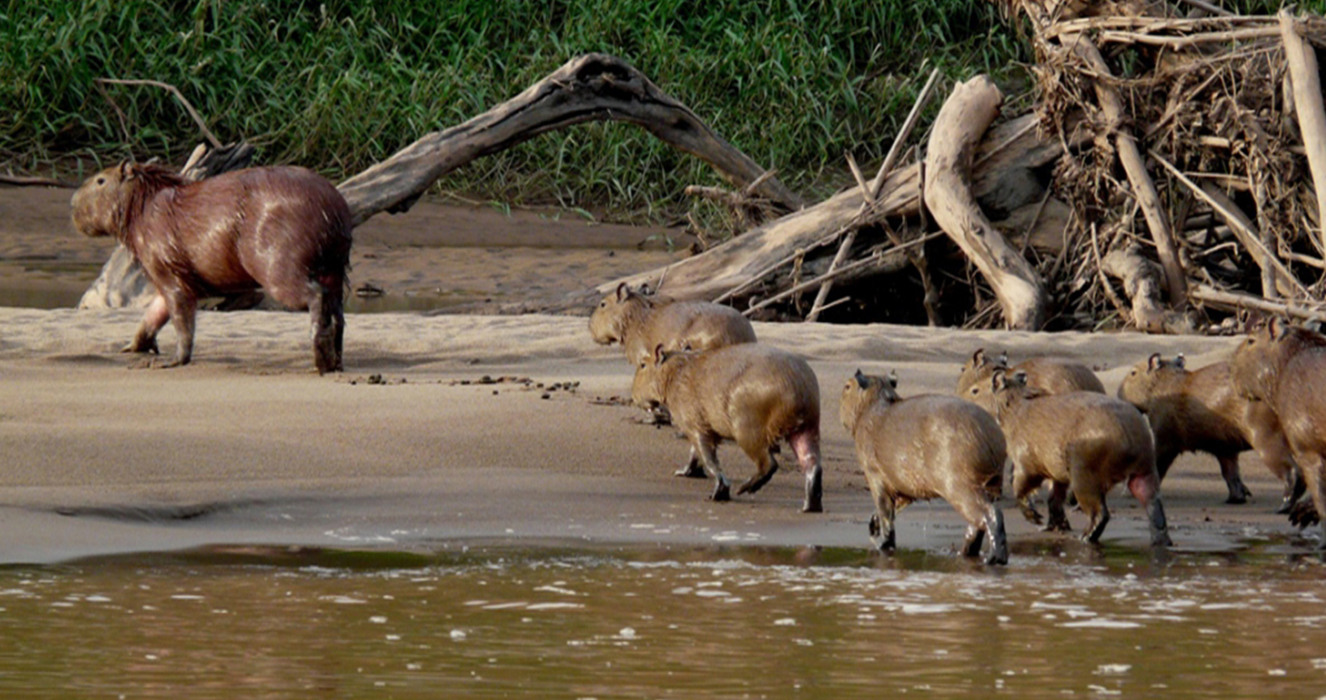
The capybara – Hydrochoerus hydrochaeris
El roedor mas grande del mundo habita la zona reservada del Manu, y podrás observarlo en su habitad silvestre.

Observation Probability |
Season |
Zone |
|---|---|---|
| 95% | All year | Manu national Park - Tambopata |
It is one of the largest rodents (Hydrochoerus hydrochaeris) in the world, perhaps one of the most seen animals on our trips to the Manu National Park. We generally find them in wetlands, swamps or on the banks of the Madre de Dios river. In general, we usually see them in groups of 5 to 10 individuals, either feeding or moving from one place to another.
Where is the capybara located?
The capybara inhabits a large territory of South America, in the countries of Brazil, Colombia, Ecuador, Bolivia, Peru, Mexico, Panama, Paraguay and Venezuela. In the case of our country Peru, we will find them in the wild in the Manu National Park and the Tambopata Reserve.
Capybara curiosities
- It is a very sociable animal, often sharing its habitat with birds that feed on parasites lodged in their fur.
- It is the largest rodent in the world, measuring 1.30 meters and weighing up to 60 kilos.
- Capybaras only reproduce in the water, as the female has an advantage over the males, she can choose who to mate with, if she does not want to mate with a male, she will dive in or out of the water.
- The capybaras eat their own eses, according to the researchers they usually do this in the morning to digest the food a second time and take advantage of the nutrients that they cannot assimilate in the first time.
- Capybaras are good divers, they can stay submerged for up to 5 minutes.
- When they feel danger, capybaras make a squeak or bark that warns others, making them run with a speed similar to that of horses until they reach the water or where they feel safer.