
Jaguar (Otorongo): Jaguars in Peru and Where to See Them
Yes, there are jaguars in Peru. The jaguar (Panthera onca), called otorongo in Peru, is the largest cat in the Americas and the third largest in the world. According to SERFOR, Peru’s forest and wildlife service, Peru has the second-largest jaguar population on the continent, estimated at about 6,000 animals, in the departments of Loreto, Ucayali, Madre de Dios, Puno, Cusco, San Martín, Junín and Pasco. Manu National Park and the Tambopata National Reserve, in southeastern Peru, are among the places where travelers look for one.
Jaguar facts at a glance
| Scientific name | Panthera onca |
|---|---|
| Name in Peru | Otorongo |
| Range | Mexico through Central and South America |
| Habitat | Dense lowland and montane tropical forest, often near water |
| Head and body length | 112–185 cm (44–73 in), plus a tail of 45–75 cm (18–30 in) |
| Weight | 57–113 kg (126–249 lb) |
| Prey | About 85 species, including capybaras, deer, turtles, fish and birds |
| Activity | Hunts mainly at night |
| Cubs | Usually 2 per litter after about 100 days of gestation |
| Lifespan in the wild | About 13–14 years |
| Conservation status | Near Threatened (IUCN, and also in Peru) |
Where to see jaguars in Peru
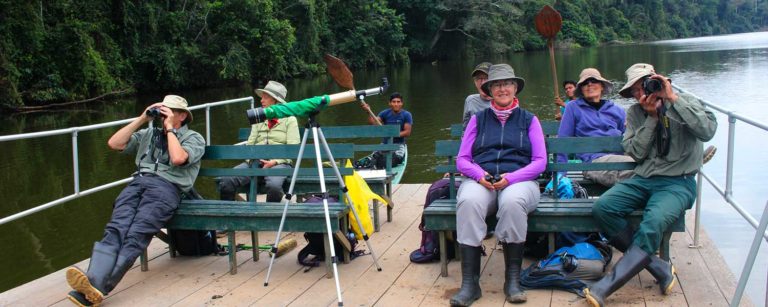
No one can promise a jaguar, but southeastern Peru gives you a real chance. On our trips into the Manu Reserved Zone, jaguars are sometimes seen resting on logs and sandy beaches along the Manu River. Hunting is not allowed in the Reserved Zone, so animals there are less shy than elsewhere. Our guides see them most often from June to October, in the dry season.
Our 6-day, 7-day and 8-day Manu Reserved Zone tours spend several days on the Manu River and around the Otorongo and Salvador oxbow lakes, where sightings happen most often. Jaguars also live in the Tambopata National Reserve.
How jaguars live
- A night hunter. Jaguars hunt mainly at night, although their activity varies from place to place.
- A varied diet. They take about 85 different prey species, from capybaras and deer to turtles and fish, and in Manu they share the forest with tapirs, peccaries and monkeys.
- Cubs. A female usually has two cubs after about 100 days. They are weaned at 5 to 6 months, and females can breed from 2 to 3 years old.
Are jaguars endangered?
The jaguar is listed as Near Threatened by the IUCN, and Peru gives it the same category. In 2022 SERFOR approved a National Conservation Plan for the jaguar for 2022–2031. Habitat loss and illegal wildlife trade are the main threats in Peru.
Sources
- San Diego Zoo Wildlife Alliance Library: Jaguar fact sheet (size, diet, reproduction and IUCN status)
- Actualidad Ambiental, August 26, 2022 (SERFOR data: population, departments, category in Peru and the 2022–2031 plan, in Spanish)
Updated October 2026.
Tours to look for the jaguar
The best chances to see a jaguar are deep in the Manu Reserved Zone, on the river beaches and oxbow lakes.

Frequently asked questions
Are there jaguars in Peru?
Yes. According to SERFOR, Peru has the second-largest jaguar population on the continent, about 6,000 animals, in Loreto, Ucayali, Madre de Dios, Puno, Cusco, San Martín, Junín and Pasco.
What is a jaguar called in Peru?
In Peru the jaguar is called otorongo. The Otorongo oxbow lake in the Manu Reserved Zone is named after it.
Where can I see a jaguar in Peru?
In southeastern Peru, mainly along the Manu River in the Manu Reserved Zone, where jaguars are sometimes seen resting on logs and beaches. They also live in the Tambopata National Reserve. No one can guarantee a sighting.
When is the best time to see jaguars in Manu?
Our guides see them most often from June to October, in the dry season. Our 6, 7 and 8-day Reserved Zone tours spend several days on the Manu River.
Are jaguars endangered?
The jaguar is listed as Near Threatened by the IUCN and in Peru. Habitat loss and illegal wildlife trade are its main threats, and Peru has a National Conservation Plan for the jaguar for 2022–2031.